Tuesday, July 5, 2011

Keyboard Notes

Learning keyboard notes is not absolutely essential for songwriting or even music theory. But it makes both much easier. And learning where notes are on a keyboard takes minutes. So why not memorize them?

If you know the place of only one note on the keyboard, the rest will be obvious.

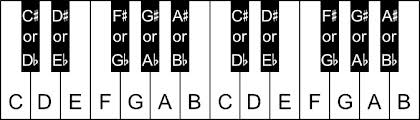
This is what a keyboard looks like:


You can probably see a pattern here. There are several white keys next to each other and there are pairs and threes of back notes between them.

White Keys
Find a pair of black notes. C is always the white note to the left of the two:


All the notes on the keyboard which are to the left from the pairs of black notes are called C, only the pitch changes. The C's on the left side of the keyboard are lower than the ones on the right.

As you probably know, in music we identify notes by names: C, D, E, F, G, A, B. Since they are in alphabetical order, it couldn't be easier to remember them. It's just that easy on the keyboard too. If you know where C is, you can identify the other notes. To the right of C there is the next white key D, the next white key is E and so on:


If I tell you to play Middle C, which note are you going to play? It's called "Middle C" for a reason, it's the C almost in the middle of the keyboard.


Black Keys

So if C, D, E, F, G, A, B are the names of the white notes, what's left for the black ones?
The shortest interval between two notes is called a semi-tone. Each key on the piano is a semi-tone away from the next. So for example, the black key to the right from C is a C# (C sharp). It means that it's a semi-tone higher than C. Therefore the black keys are called (from left to right): C#, D#, F#, G#, A#.

There is a semi-tone difference between E-F and B-C so there is no black key between them.
You can also approach these keyboard notes from another angle and instead of C# you could call the same black key a D♭ (D flat). It means that it's a semi-tone below D. If you look at a keyboard, you'll realize that C# and D♭ are identical.


If you'd like to master music theory in even more detail, I recommend Alfred's Essentials of Music Theory. It's an awesome self-study course. There are even ear training CDs included. You can practice music theory with music writing and reading exercises and tests. Answers are also included so you can really do it all without the help of a teacher.


If you'd like to learn to play the piano, you've made the first step by learning what keyboard notes are called. The next step is to find a systematic course that will take you from complete beginner to quite an advanced level. The best one I've found is called Learn and Master Piano. Will Barrow (a Grammy-winner pianist) is the instructor and he has a really clear, down-to-earth teaching style. Highly recommended!

More Music Theory 

Sunday, July 3, 2011

Note Lengths

Note lengths differ. If they didn't, music would be a very boring series of notes.
Fortunately, there is an easy way to see and compare different note durations. And if you learn these, you'll almost be able to read music. Of course, you'll also need to learn about where notes are in the staff. But if you master these two things, you can read almost any sheet music.

Note Durations
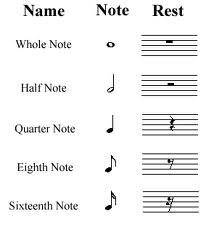
Here is a chart of note lengths:


It's all basic mathematics:
⁃ Two half notes = a whole note.
⁃ Two quarter notes = a half note.
⁃ A half note + two eighth notes + a quarter note = a whole note.
By the way, there are much shorter notes than sixteenth notes but they are not used very often.

Dotted Notes
This is an example for a dotted quarter note:


The dot after a note means that you increase the note by half of its value. It's the same as if you wrote a quarter note + an eighth note. You can make any note dotted and therefore increase its value by half.

Ties
You can also increase note length by adding a tie to it:


A tie means that you have to add up the value of the notes you tie together.

Beams
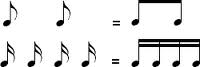
Sometimes there are several quarter, eighth, sixteenth or even smaller notes next to each other. They would be hard to read. And it would look strange on the staff to write several of them next to each other. To simplify this, you can use beams to connect them inside a bar.
You can connect eighth notes with one line (beam), and sixteenth notes with two:


Direction of Stems
The line coming from the egg/circle part of a note is called a stem. You've probably noticed when looking at sheet music that sometimes the stem points up, sometimes down. How do you decide which direction to go?

• If the note is below the middle line, the stem points up.
• If it's above the middle line, the stem points down.
• If it's ON the middle line, the stem can go either way, whichever looks better to you.


Rests
In music, silence is called a rest. Rests also have a value and are written into the sheet music:


Related pages:

How To Read Music Notes 

Keyboard Notes 

Musical Staff

The musical staff has five lines and four spaces. We count the lines and spaces from the bottom up. So we can say: "the note on the second line" or "the note on the third space". The staff may have more or less than five lines but in modern music it's uncommon.

Clefs
Where you find notes on the musical staff will be determined by the clef at the beginning of each line of music. The two most common clefs are the treble clef and the bass clef.

Notes on the Staff - Treble Clef
In music, notes have letter names: C, D, E, F, G, A, B. (Some countries in Europe use the letter H instead of B.)

In the treble clef staff, you put E on the first line (i.e. the first line at the bottom). Then you go on naming the other notes from there. F will be on the first space, G on the second line, etc. When you get to E on the fourth space, you just start the circle again and continue with F, G, etc. You'll easily memorize the places of notes if you remember the word FACE(from the bottom up) for the spaces and Every Good Boy Does Fine (again from the bottom up) for the lines.


Notes on the Staff - Bass Clef
The system of naming notes in bass clef is the same as in treble clef. However, you'll find G on the first line. Then comes A on the first space, B on the second line, etc. You'll easily remember the places of the notes if you remember the sentence All Cows Eat Grass (from the bottom up) for the spaces and Good Boys Do Fine Always (similarly, from the bottom up) for the lines.


Notes on the Staff - Ledger Lines
Sometimes music includes notes lower or higher than what you can put into the musical staff. That's when you use ledger lines. For example, if you have a piece of music which starts with treble clef, there might be a B in it which is lower than E on the first line. In that case, you'll have a little extra line under the first line and place the note B under that. There might be one or more ledger lines below or over the musical staff, whether the music is written down in treble clef or bass clef. Theoretically, you can use as many ledger lines as you like - only the available space will limit the number.


Notes on the Staff - Middle C
In treble clef, Middle C is on the first ledger line under the staff. In bass clef, Middle C is on the first ledger line above the staff. It means that they are identical notes. On the piano, it's the C literally "in the middle".


The Gand Staff
When you have a treble clef line and a bass clef line, and they are joined by a line, you call it the grand staff. You use it in cases when two or more instruments play at once and/or when an instrument is capable of playing several notes at the same time, e.g. the piano.


Practice Makes Perfect!
The only way to memorize where the notes are in treble and bass clef is to practice them. For example, you could choose a piece of music you'd like to learn to play on the piano and (without writing the note names under the musical staff) learn to play and read it. The more you practice it the faster and easier you'll read music. Even if you don't play the piano, if you visualize notes on a keyboard, it'll be much easier to remember the system of music notes.


If you'd like to practice the musical staff and reading music more, I recommend The Everything Reading Music Book. There is great step-by-step music theory instruction in it. This book doesn't bore you with unnecessary technical terms that you'll never use!

More Music Theory 

Wednesday, June 29, 2011

Musical Bars

Musical bars are the vertical lines you see in sheet music. You can also call them measures. We divide longer pieces of music to smaller pieces, i.e. bars. After each measure there is a bar line.


To be able to decide where a measure ends and the next one begins, you'll need to understand what time signature is. The time signature is those two numbers you'll find at the beginning of each line in sheet music. These numbers will tell you how many notes will go into each musical bar. The top number tells you how many beats there are in the measure. And the bottom number tells you what note gets the beat.

For example, if the time signature is 3/4, there will be 3 quarter notes in each bar (or mathematically equivalent notes - see the note lengths and rests page to see what I mean by mathematically equivalent notes).

Most contemporary music is 4/4 or 3/4 time but you can also find songs in 3/8 and 2/4 time.
If you get the task to decide where bar lines go in a piece of music, first check the time signature. Then simply start counting the notes and put a bar line where you need to.

For example, in 3/4 time, I would need a bar line after each three quarter notes (or equivalent). Then I'd start counting over again and put the second bar line after the second three quarter notes (or equivalent) and so on.

Be careful, however, because sometimes the time signature changes somewhere during the piece of music. If it does, you'll need to count the notes according to the new time signature until the end of the music or until there is a new time signature again.

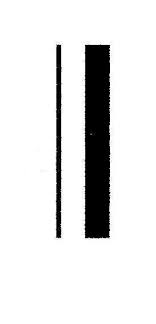
At the end of each piece of music, you'll find a double bar line. It means that you've reached the end of the song or piece of music.


More Music Theory

Wednesday, June 15, 2011

How to Copyright A Song

It's easy to learn how to copyright a song. And it's important to understand why you should do it and what kind of rights you'll get when you go through the process.


Disclaimer: I'm not a lawyer. Don't take anything I say here as legal advice. I've collected this information as carefully as I could from professional resources but if you need legal advice, consult a lawyer.

What's Copyright?
When you copyright a song, nobody checks if the song is original. All a copyright does is prove the date of the registration.

You don't have to copyright a song for it to be "yours". Once you create something, you own the copyright. There's nothing you have to do. However, if you ever need to prove that it's your work, it's much easier to do if you have registered it at The Copyright Office. And you can do the registration any time, even for songs that you wrote 20 years ago. The effective date of registration is the date when the Copyright Office receives all the documents they need from you.

The song you register must be in a tangible form, of course. For example, you can submit it on paper (lyrics and sheet music) or on a "phonorecord" (a tape or a CD).

Although most songwriters know how to copyright a song, they do it only after the demo is done. Anyone stealing your song is quite unlikely. It rarely happens. Mostly the rich and famous are sometimes accused of copyright infringement but 99% of the time they are innocent and they can prove it.

What Are Your Rights?
If you'd like to learn how to copyright songs, you need to understand what rights you'll have once you do it:


✓ You can reproduce the copyrighted song (CD's, tapes and sheet music)
✓ You can create derivative works from the song (samples, compilations, etc.)
✓ Distribute it to the public, transfer ownership, rent, lease or lend it.
✓ You have the right to perform the song publicly (TV, radio, etc.), and collect royalties through one of the performing rights organizations, such as ASCAP, BMI or SESAC.
✓ You can display the copyrighted song publicly (karaoke, etc.)

What Can't You Copyright?
If you copyright a song, it doesn't mean that you own every little part of it for good. There are several things that you cannot copyright, no matter what:

▪ Ideas or concepts
▪ Titles or lines, phrases from your lyrics
▪ Chord progressions
▪ Rhythm patterns

How Long Does Copyright Last?
How long copyright lasts depends on when you created, published and registered the song. The laws on the 'how long does copyright last' page are valid in the United States.

Copyright Registration
Would you like to know how to copyright a song online? It's easy and I strongly recommend that you do it if you can because it's cheaper and simpler. The online registration costs $35 now. The paper version is $50. To find out how to copyright your song on the internet and what other ways are available, visit the 'Copyright on the Internet' page.


Cheaper Copyright Registration
If you'd like to save money, you can register your songs as a "collection" and give it all one title (and pay the fee of $35 or $50 for all of them together). You might also include the real titles of the songs but if someone would like to look up the copyright information of your song (to get in touch with you), they will find it only under the name of the "collection" and not the individual songs.


Poor Man's Copyright
Since registering copyright isn't cheap at all, some resourceful person/people invented the "poor man's copyright". It means that you send your song to yourself by registered mail. And when you get it, you don't open the envelope. This way the postal stamp will certify when the work was created. It's not such a good idea to do though. You might lose the envelope. Or maybe it just won't be a good enough evidence in an infringement trial. So this is not how to copyright a song properly.


How to Copyright a Song and Let the World Know About It
To make sure that it's clear to everyone that you own the copyright to a certain song, you should put a copyright notice on the sheet music or on any tangible product.


1. Put the © symbol somewhere, or write "copyright" or "copr.".
2. Include the year of the first publication of your song.
3. Write down the name of the owner(s) of the copyright.


Example: © 2010 John Smith


If your song is not in a tangible form but it's a CD or tape, you should do the same as in the previous case but instead of a © symbol, use a ℗ symbol, which is short for 'phonorecord'.


To find out more about how to copyright a song and how copyright works in this modern, digital era, I recommend that you read Allen Bargfrede and Cecily Mak's book, Music Law in the Digital Age. It's not only about regular copyright matters but also new issues, like delivering music on the internet, YouTube, MySpace, etc.


How to Register Copyright on the Internet 
How Long Does Copyright Last?

Monday, June 6, 2011

How To Read Music Notes

Fortunately, learning how to read music notes is not as difficult and mysterious as some might think. There are a few very simple rules/signs to remember. And if you learn or recognize those, voila, you can read music. You'll be able to play any song that you can get your hands on.

Notes
The following notes exist: A, B, C, D, E, F, G. They repeat up and down on the scale (or piano).

These notes also have sharp and flat versions. It means that A♯ (i.e. A sharp) is half a note (step) high than A and A♭ (i.e. A flat) is half a step lower than A.
There are also "en-harmonic" notes. It means that there is a note that has two different names. For instance, A♭ is the same note as G♯. It's an identical note, however, you can "approach" it in two ways.


The Staff
The five lines that you see in the sheet music is called the staff. You can place notes ON the lines and BETWEEN the lines. Sometimes if there is a particularly high or low note, you can even add one or more short lines below or above the original five.

The staff always contains several measures (or bars) that divide the music into small, comprehensible pieces. These measures are divided by bar lines.
At the end of the song, there are two lines, a thinner and a thicker one. It means that the music ends there.

This is the most basic step in learning how to read music notes.

Time Signatures
Often you'll find a time signature at the beginning of the staff (right after the clef sign). There are always two numbers there, one on the top and one on the bottom.

The top number shows you the number of beats in each measure (or bar). The bottom number tells you what kind of note gets a full beat. It's all maths. The most common time signatures in popular music are 4/4 and 3/4.

Note Lengths
Note lengths are one of the most important pieces of knowledge you can have if you want to learn how to read music notes. You'll find four main types of notes in sheet music. They show you how long you have to hold the notes when you play them:


If there is a 4/4 measure, for example, you can play any combination of notes as long as their values add up to 4 beats. You could play one half note (2 beats) and four eighth notes (another 2 beats) and this way get 4 beats. And you thought mathematics wasn't important for musicians? :)There are also so called "dotted notes". It's easy to recognize them: there is a little dot right after the note.


The dot increases the duration of the note by half of its original value. E.g. if a note lasts 2 beats, the dotted note lasts 2+1 that is 3 beats. Any number of dots may be added to a note, however, usually there is only one.Note: if we play several notes at the same time, we have a chord. More about chords and how to learn them in minutes here: Keyboard Chords


Key Signatures
You'll find the key signatures (a group of sharps and flats) at the beginning of the staff. They help you a lot in showing how to read music notes. Key signatures show you the key of the song and which notes are sharp or flat in that key. I've written a separate page about key signatures.


Octave Placement Notation
A piano contains 88 keys. That's a lot of octaves. And that's why sometimes you'll see octave placement notations in the sheet music. These signs are always followed by a dashed line which tell you how long this modification lasts.


Treble Clef
The treble clef is this famous and beautiful sign that you often see at the beginning of the staff (and as necklace pedants). It tells you what notes the different musical notes in that line correspond to.

The C that you can find on the first added (ledger) line below the lowest line in the staff is middle C. If you have a piano, you'll find this note around the middle.

An easy way to memorize line and space names in treble clef is to remember to spell FACE from bottom up (for the spaces) and memorize the following: Every Good Boy Does Fine because the first letters of it represent the notes on the lines.


Bass Clef
The bass clef is the other sign that you often see at the beginning of the staff. Just like the treble clef, it tells you what notes the different musical notes in that line correspond to.

The C that you'll find on the first ledger line above the highest line in the staff is middle C.

An easy way to memorize the letters for the bass clef lines and spaces is to remember Good Boys Do Fine Always (for the lines) and memorize the following: All Cows Eat Grass (for the spaces).


Why is there a separate staff for treble AND bass clef sometimes?
It's especially important to know for budding pianists who want to know how to read music notes. If there are two lines of staff (one treble and one bass line) in the song, it's made so that you can play the song on the piano. You must play the notes in the treble clef with your right hand, and the notes in the bass clef with your left hand. The bass line usually gives a rhythmic foundation to play under the main melody.


The Natural Sign
The natural sign looks like this: ♮. It indicates an unmodified pitch. Placed before a specific note, it cancels out a flat or sharp that's in the key signature or negates a sharp or flat established earlier in the bar.


Rests
Often there is a shorter or longer pause in music. Of course, there is a way to show it in sheet music.


Repeat Sign
A repetition of a musical passage is indicated by the use of a repeat sign. You need to repeat the music that's before this sign. It's essential to know for learning how to read music notes.


Tempo
The tempo tells you the speed of a song. It's measured in beats per minute (BPM). You'll find it at the beginning of the sheet music. There are two forms: "♪ = 76" or "76 BPM".


Triplets
A triplet is a grouping of three notes to a beat. Usually they contain three eighth notes. But it's a more advanced part of learning how to read music notes.


Ties
A tie is a curvy line that connects two notes. It means that the time values of the connected notes have to be added together. For example, a whole note tied with a half note in 4/4 time would mean it has to last 6 beats (4+2).


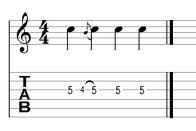
Grace Notes
Grace notes add color to the music. They are usually a half or a whole step below or above the note that follows. They are smaller than the "main" notes. However, grace notes are not that common but they are good to know about if you want to learn how to read music notes well.


First and Second Endings
They are a way of repeating a section of music but each time with a different ending. When you play it first, take the first ending, when you play it second, take the second ending.


Well, I guess this page must have answered most of your questions about how to read music notes. If you would like to familiarize yourself even more with reading music, I recommend:

Learn & Master Piano or Learn & Master Guitar. They are comprehensive piano and guitar instruction courses that come with DVDs, CDs and a course book to help you master your instrument. I've used Learn and Master Piano and it's amazing. It takes you from a complete beginner to advanced level. It think it would've taken me at least 5 years to get to the place where you go can with this course in a couple of months.

✓ I also like The Everything Reading Music Book. It's a step-by-step introduction to understanding music notation and theory.


I borrowed the illustrations on this page from the Learn & Master Piano course book which contains even more details about how to read music notes.

Learn Thousands of Chords In Minutes HERE! 

More Music Theory 

Wednesday, June 1, 2011

Music Scale

A music scale is a series of notes, which ascend and descend in a specific order. Usually the notes of a scale belong to a single key. So they provide material for or being used to conveniently represent part or all of a musical work, together with the melody and harmony. Scales are ordered in pitch. The two most important categories in popular music are the major and minor scales.

Major Scales

Major scales sound bright and lively. All scales begin and end with the same note. For example, the F major scale begins with an F note and then ends with an F note. It's true for all the other keys.

A major scale consists of two whole steps, one half step, three whole steps then a half step again: WS-WS-HS-WS-WS-WS-HS (WH stands for whole step, HS stands for half step, i.e. a whole note and a half note.)


Only the C major scale HAS no sharps or flats in it.
So here are all the major scales:


Minor Scales

A minor music scale sounds melancholic. melancholic. There are three types of minor scales:

Natural Minor Scale
Here are all the natural minor scales:


Natural minor music scales have a whole step, a half step, two whole steps, a half steps, and two whole steps formula: WS-HS-WS-WS-HS-WS-WS.

Harmonic Minor Scale
Raise the seventh note of the scale by a half-step as you go up and down the scale. For example:


Natural C Minor Scale = C - D - Eb - F - G - Ab - Bb - C

Harmonic C Minor Scale = C - D - Eb - F - G - Ab - B - C

Melodic Minor Scale
Raise the sixth and seventh notes of a scale by a half step as you go up the scale and then return to the natural minor as you go down the scale. For example:


Melodic C Minor Scale = C - D - Eb - F - G - A - B - C (as you go up the scale)

Natural C Minor Scale = C - D - Eb - F - G - Ab - Bb - C (as you go down the scale)

More about Music Theory